


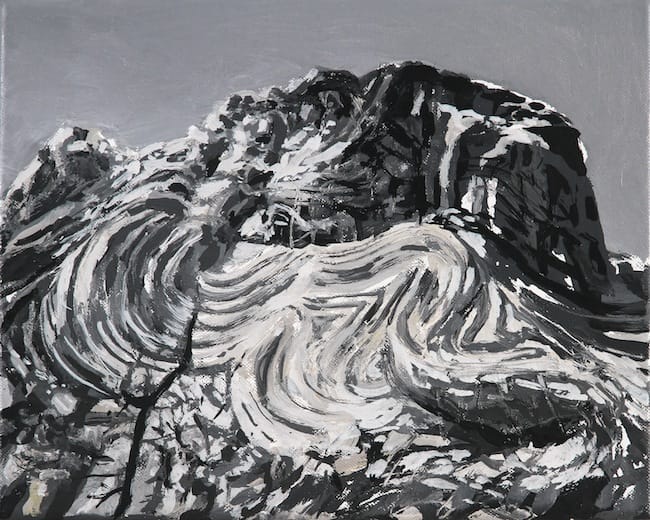

Tuca Culebres
SF-P 15-4
Unique
Signed
Sergio Frutos
, 2015
Oil on canvas
24 x 30 x 2 cm
SF-P 15-4
Unique
Signed
 View in a room
 Download PDF
About the project: VALLIBIERNA
My name is David.
I’ve spent most of my life telling the stories of others—of birds, forests, oceans, and dying species.
And today... I sat in silence.
No camera. No crew. Just me.
And for a moment, I wondered if anyone truly understood how heavy these stories have become.
Today, I spoke of a rainforest that no longer exists.
I watched footage of a glacier I once stood upon... now vanished.
Sir David Attenborough, 2025
The name Vallibierna, which refers to a mountain and a valley in the Pyrenees, comes from the combination of the words “valle” (valley) and “hiberna” (hibernate). The area encompasses the highest peaks in the Pyrenees, a remote spot that has remained untouched until recently.
This series is developed manly from dia-films from my father, shot in the 1970’s in the Pyrenees, which depict the valleys back then empty and wild and now menaced by tourism and global warming.
This project revolves around how the human action has changed the world in an unstoppable tide, centered on the effects on mountain ranges1 and developed as a dialog between generations, working from the photographs took in the 70s to talk about the present day. Humans have fundamentally altered global patterns of biodiversity and ecosystem processes, replacing them with new ones of anthropogenic origin.2 Mountain areas and specifically glaciers are a very sensitive component of the biosphere.3
Alexander von Humboldt analized he data on humidity, temperature and plant species that he recorded at different altitudes as he climbed with Aimé Bonpland to the summit of Chimborazo.4 Shortly thereafter, he organized the temperature data in the different regions of the planet and created the first isotherm map (lines of equal temperature), which inspired the creation of isobars (lines of equal atmospheric pressure) and prompted the birth of a new climate science. It was at the end of the 20th century that some researchers began to reveal an unexpected and disturbing reality. Human activity was shifting some of those lines, especially those that have to do with life. The increase in temperature due to our emissions, the invasion of ecosystems and our conflicts are altering the configuration of the planet on a scale never seen before.
The intense bombings of World War II changed the height of the ionosphere5 and nuclear tests carried out during the following decades altered the atmospheric configuration and even moved the Earth's radiation belts.6 Our CO2 emissions are contributing to the acidification of the ocean and the line that marks the acidity level that prevents the formation of shells of millions of microorganisms is moving at an accelerated rate. These critical zones, which are generically known as “saturation horizons”, have moved by 50 to 200 meters compared to the levels they were at the beginning of the 19th century.7
A few years ago, upon returning to Chimborazo and reviewing Humboldt and Bonpland's data, a team of researchers discovered that, two centuries later, the lines marked by the two naturalists had also shifted.8 The growth limit of many of the plant species they had documented in 1802 had risen more than 500 meters, from 4,600 to 5,185 meters. On Teide, a team of Spanish researchers recently discovered that the violets documented by Humboldt as he passed through Tenerife in 1799 had also risen from 3,300 to 3,700 meters, a 400-meter upward race that will soon leave them with no room to escape.9
Observations show general decline in the cryosphere (snow, glaciers, permafrost, lake and river ice) due to climate change in recent decades. The cryosphere is an integral element of high mountain regions, which are home to roughly 10% of the global population. Widespread cryosphere changes affect physical, biological and human systems in the mountains and surrounding lowlands, with impacts evident even in the ocean.10
This process embodies to me the expression of how unconsciously we are immerse in the irrefrenable change of the planet's face. About the glaciers in the Patagonia, a journalist11 recently wrote: “The hordes of visitors who celebrate every time a huge chunk of the imposing Perito Moreno glacier breaks off, ignore the danger for the inhabitants of El Chalten that the imposing ice mass is retreating at full speed due to the impact of climate change.” More recently, a huge portion of a glacier in the Swiss Alps has broken off from the mountainside, sending rock, mud and ice crashing onto the village of Blatten.12 There are no reports of casualties, although the village of Blatten is now largely buried under rubble. “Nature is stronger than man. The mountain people know that. But today we experienced an extraordinary event. The event has left us speechless, and it’s shocking to see the images,” said Federal Councillor Albert Rösti.
At the heart of Vallibierna, where just a few hikers seeked for isolation in the wilderness half a century ago, now massive race trails take place.13 Overcrowded or “Last chance tourism” —a growing trend where travellers rush to visit places doomed to disappear—, is certainly not going to reverse the trend. On the contrary, the influx of visitors only serves to further weaken ecosystems that are already in danger.14
The romantic myth of the victorian explorer has decayed as these unknown regions, the wilderness, have disappeared.
There are no ‘Hic sunt Draconis’ left and these glaciers don’t exist anymore.
-
I. Vidaller et al., “Toward an Ice-Free Mountain Range: Demise of Pyrenean Glaciers During 2011–2020,” Geophysical Research Letters 48, no. 18 (2021). →
-
Erle C. Ellis and Navin Ramankutty. “Putting People in the Map: Anthropogenic Biomes of the World,” Frontiers in Ecology and the Environment 6, no. 8 (October 2008): 439–47. →
-
Eñaut Izagirre et al. “Pyrenean glaciers are disappearing fast: state of the glaciers after the extreme mass losses in 2022 and 2023,” Reg Environ Change 24, 172 (2024). →
-
Alexander von Humboldt, Essay on the Geography of Plants. Chicago: University of Chicago Press 2009. →
-
Christopher J. Scott, and Patrick Major. “The Ionospheric Response over the UK to Major Bombing Raids during World War II.” Annales Geophysicae 36, no. 5 (September 26, 2018): 1243–54. →
-
Angela N. H. Creager, “The Radioactive Footprint of the Anthropocene.” Max Planck Institute for the History of Science; Haus der Kulturen der Welt, 2022. →
-
Royal Society (Great Britain). Ocean Acidification Due to Increasing Atmospheric Carbon Dioxide. Royal Society of London; 12/05. London: Royal Society, 2005. →
-
Naia Morueta-Holme et al., “Strong Upslope Shifts in Chimborazo’s Vegetation over Two Centuries since Humboldt.” Proceedings of the National Academy of Sciences 112, no. 41 (October 13, 2015): 12741–45. →
-
Bello-Rodríguez et al., “Velocidad de respuesta al cambio climático de las especies del género ‘Viola’ en la alta montaña de Canarias”. Conservación Vegetal, no. 25 (December 2, 2021): 16–19. →
-
Intergovernmental Panel On Climate Change (IPCC). The Ocean and Cryosphere in a Changing Climate: Special Report of the Intergovernmental Panel on Climate Change. Cambridge University Press, 2022. →
-
Jorgelina Hiba, “El Riesgo de Vivir a Los Pies de Un Glaciar Que Desaparece,” Eldiario.es, May 2025. →
-
Madeleine Cuff, “Massive Glacier Collapse Triggers Landslide That Buries Swiss Village,” New Scientist, May 2025. →
-
Antonio Cerrillo, “Carreras de montaña: al filo de lo insostenible.” La Vanguardia, January 12, 2014. →
-
Agnès Bardon, “Vanishing glaciers.” UNESCO Courier, January 2025. →