


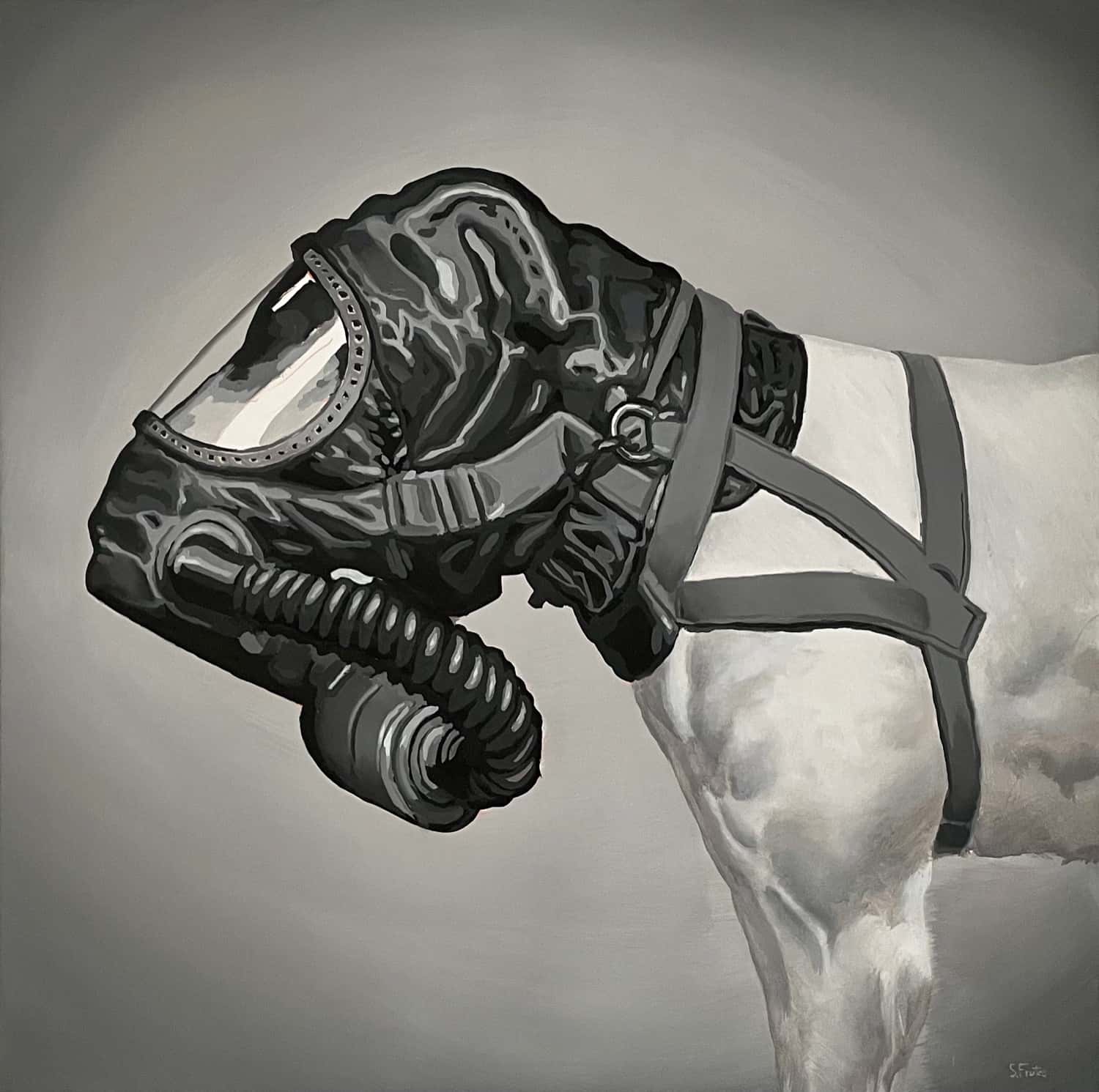

US War Dogs I
SF-P 25-01
Unique
Signed
Sergio Frutos
, 2025
Acrylic on canvas
130 x 130 x 2 cm
SF-P 25-01
Unique
Signed
 View in a room
 Download PDF
About this artwork:
Dogs have a very long history in warfare, beginning in ancient times. From being trained in combat, to their use as scouts, sentries, messengers, mercy dogs, and trackers, their uses have been varied, and some continue to exist in modern military usage.
With the introduction of chemical warfare in World War I, soldiers had to protect themselves and their animals in order to survive and fight. Horses, mules, dogs, and pigeons all required protection from the effects of chemical warfare.
Early in World War II, as the Quartermaster Corps began training dogs for its new War Dog Program, colloquially known as the Army’s ’K-9 Corps’,1 more than thirty breeds were accepted. But later, with more experience, the list was narrowed to five: German Shepherds, Belgian Sheep Dogs, Doberman Pinschers, Farm Collies (short coat) and Giant Schnauzers. Rejected breeds included Great Danes, difficult to train because of their size, and hunting dogs because animal scents occupied their attention. Alaskan Malamutes and Huskies were still trained for Arctic duty as sled dogs.2
This work brings us an unease feeling, double sided: on one hand, the strangeness that such a militaristic anthropomorphization evokes —assigning and embedding these animals into human categories as ‘soldiers’ and even ‘heros’—, and on the other, highlights the operation of contemporary biopower, understood as the controlled insertion of bodies into the machinery of production and the adjustment of the phenomena of population to economic processes.3
This operation of biopower would express the human agency trumping other animals, categories are sometimes inverted, they are flimsy and reversible: the dogs’ status changed from heroes —set for moments above human soldiers— to mere machinery, pressed below even animals, in order to excuse official United States policy to abandon the dogs in Vietnam when the United States withdrew.
Soldiers’ love for their canine partners heightened the teams’ effectiveness, but it also sharpened the soldiers’ sense of loss, contradiction, and betrayal in the face of the dogs’ abandonment, helping to inspire a legal change in U.S. policy regarding military dogs in 2000.4
Although animals are often forced to participate in human wars, their presence also signals human vulnerability and dependence. even in the horrible circumstances of war, powerful sympathies nonetheless flourish between humans and animals.5
Dogs have been used to teach us who is and isn’t human. Our obligation and responsibility to the gift that dogs bring is to undo the oppressive story of Man, which institutes untold amounts of suffering and oppression across species, and to tell new stories in its place.6
-
Erin E. Thompson, “Army Quartermaster Corps Begins Training War Dogs,” Defense Visual Information Distribution Service, 2024. →
-
“Types of War Dogs,” US War Dogs Heritage Museum. →
-
Michel Foucault, The History of Sexuality: An Introduction. New York: Pantheon Books, 1978. →
-
Ryan Hediger, “Dogs of War: The Biopolitics of Loving and Leaving the U.S. Canine Forces in Vietnam,” Animal Studies Journal 2, no. 1 (January 1, 2013) →
-
Ryan Hediger, ed., Animals and War: Studies of Europe and North America. Leiden: Brill, 2012. →

-
Shandell Houlden, Gone to the War Dogs: An Analysis of Human-Canine Relationality in Twenty-First Century Conflict and War. PhD diss., Hamilton, Ontario: McMaster University, 2019 →
About the project: STRANGER TIMES
Humanity's self-alienation has reached such a degree that it can experience its own destruction as an aesthetic pleasure of the first order.
Walter Benjamin. The Work of Art in the Age of Its Technological Reproducibility, and Other Writings on Media. Cambridge: Harvard University Press, 2008.
Stranger Times develops from research on archival photographs, mainly from II World War and Cold War, about bizarre chemical and biological war developments and examines the human enormous capacity of normalizing and banalizing the barbarism.1 How much can we pretend that everything is ok when the world falls apart around us? To what extent are we exempt of responsibility?
We are in a theater where the familiar becomes strange, ‘verfremdet’ as in Brecht.2 It represents that uneasy tendency perhaps most poignantly, as it harasses the sanctity of the family, the society and the bourgeoisie, suggesting that any nostalgia we might have for their old, solid versions, should be abandoned, as according to two German and one Brooklyn's classics, "all that's solid, melts into air",3 and sentimental attachments are neither helping to stop this process, nor to emancipate.
Stranger Times tells us about the strangeness, the perplexity before the modern era and its absurdities, and the normalization and trivialization of these absurdities and their terrible consequences. Everyday life goes on while the world collapses around us, and we get used, banalize, adapt to the disaster or even gather to watch it as a spectacle. These paintings represent a not too distant past, or a future closer than we might think.
The old world is dying, and the new world struggles to be born: now is the time of monsters.
Antonio Gramsci, Prison Notebooks. London: Lawrence & Wishart, 1971; repr., London: ElecBook, 1999, 554.
Presumably reformulated by Slavoj Žižek from a loose French translation by Gustave Massia.
-
Hannah Arendt and ʿAmos Elon. Eichmann in Jerusalem: A Report on the Banality of Evil. New York Toronto London: Penguin Books, 2006. →
-
Francesco Fiorentino. “Ansätze Zu Einer Pädagogik Der Fremdheit Bei Brecht.” In The Brecht Yearbook / Das Brecht-Jahrbuch 45, 102–15. Boydell and Brewer Limited, 2020. →
-
Karl Marx and Friedrich Engels. Manifesto of the Communist Party. Marx/Engels Selected Works, Vol. One. Moscow: Progress Publishers, 1969. →