

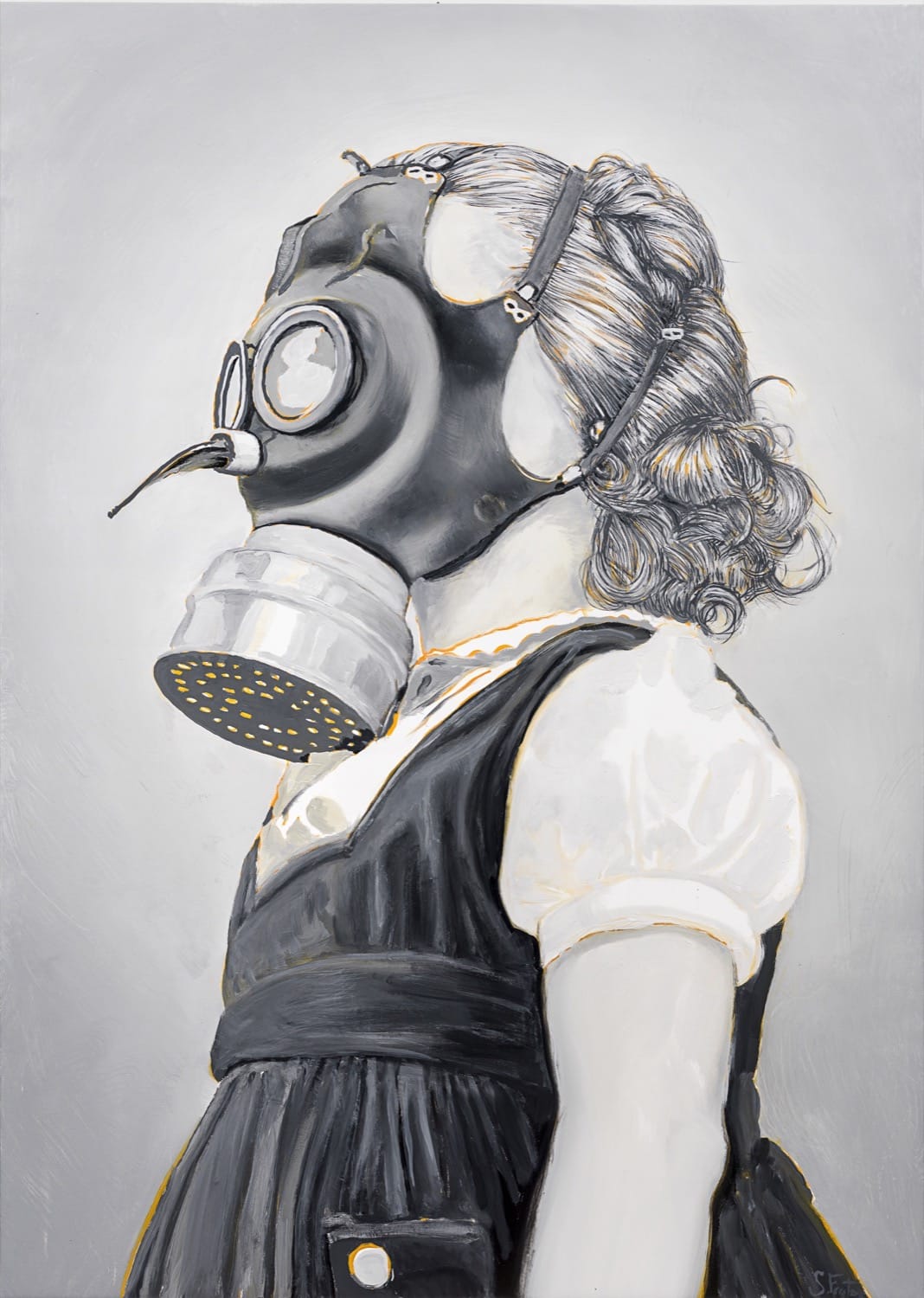

Children's Gas Mask
Vancouver, 1941
SF-P 20-11
Unique
Signed
Sergio Frutos
, 2020
Oil on canvas
140 x 100 x 4 cm
SF-P 20-11
Unique
Signed
 View in a room
 Download PDF
About this artwork:
A.R.P. children's gas mask. City of Vancouver Archives, 1943
About the project: STRANGER TIMES
Humanity's self-alienation has reached such a degree that it can experience its own destruction as an aesthetic pleasure of the first order.
Walter Benjamin. The Work of Art in the Age of Its Technological Reproducibility, and Other Writings on Media. Cambridge: Harvard University Press, 2008.
Stranger Times develops from research on archival photographs, mainly from II World War and Cold War, about bizarre chemical and biological war developments and examines the human enormous capacity of normalizing and banalizing the barbarism.1 How much can we pretend that everything is ok when the world falls apart around us? To what extent are we exempt of responsibility?
We are in a theater where the familiar becomes strange, ‘verfremdet’ as in Brecht.2 It represents that uneasy tendency perhaps most poignantly, as it harasses the sanctity of the family, the society and the bourgeoisie, suggesting that any nostalgia we might have for their old, solid versions, should be abandoned, as according to two German and one Brooklyn's classics, "all that's solid, melts into air",3 and sentimental attachments are neither helping to stop this process, nor to emancipate.
Stranger Times tells us about the strangeness, the perplexity before the modern era and its absurdities, and the normalization and trivialization of these absurdities and their terrible consequences. Everyday life goes on while the world collapses around us, and we get used, banalize, adapt to the disaster or even gather to watch it as a spectacle. These paintings represent a not too distant past, or a future closer than we might think.
The old world is dying, and the new world struggles to be born: now is the time of monsters.
Antonio Gramsci, Prison Notebooks. London: Lawrence & Wishart, 1971; repr., London: ElecBook, 1999, 554.
Presumably reformulated by Slavoj Žižek from a loose French translation by Gustave Massia.
-
Hannah Arendt and ʿAmos Elon. Eichmann in Jerusalem: A Report on the Banality of Evil. New York Toronto London: Penguin Books, 2006. →
-
Francesco Fiorentino. “Ansätze Zu Einer Pädagogik Der Fremdheit Bei Brecht.” In The Brecht Yearbook / Das Brecht-Jahrbuch 45, 102–15. Boydell and Brewer Limited, 2020. →
-
Karl Marx and Friedrich Engels. Manifesto of the Communist Party. Marx/Engels Selected Works, Vol. One. Moscow: Progress Publishers, 1969. →