




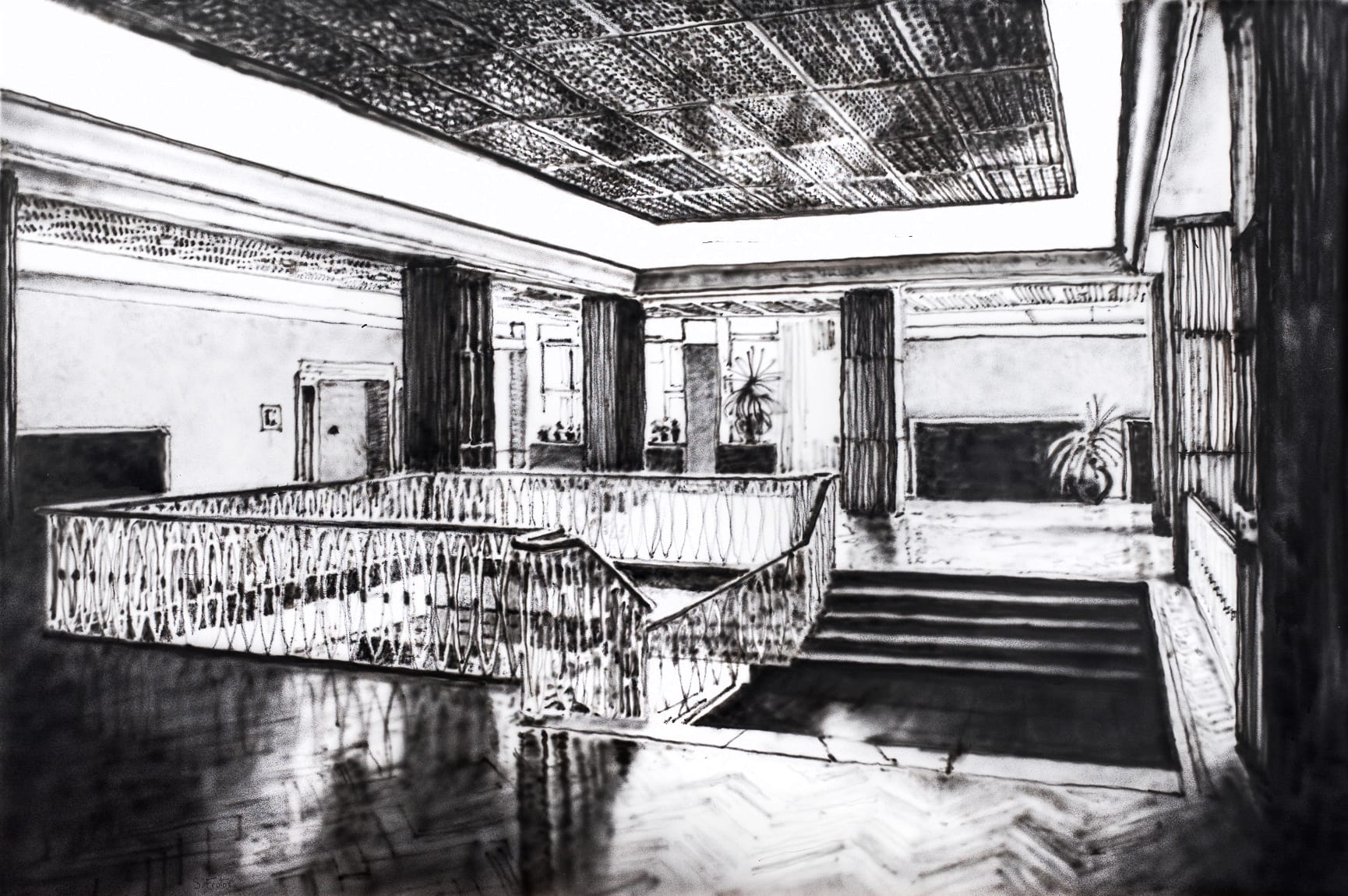

Funkhaus
SF-P 18-117
Unique
Signed
Sergio Frutos
, 2018
Ink on paper
120 x 180 x 4 cm
SF-P 18-117
Unique
Signed
 View in a room
 Download PDF
About this artwork:
An empty building complex of a former plywood factory in Nalepastraße, located in the Soviet sector of Berlin, was converted into a broadcasting centre in the summer of 1951. One year later, the conversion (called Block A) had progressed so far that from September 12-13, 1952, four broadcast studios and further recording rooms as well as the necessary control room could be used for full broadcasting of the central radio programmes of the GDR.
The studio buildings of the Funkhaus Berlin fascinate with their architecture, sound quality, optimal reverberation time and good studio equipment. A-ha, Sting and the Black Eyed Peas recorded their albums in the recording studios. After the fall of communism, Daniel Barenboim and Kent Nagano also recorded symphonies and operas in the Great Recording Room 1, while major music labels such as Universal, BMG, Sony, EMI and the Teldec regularly use the studios for music productions of all styles.
Sounding names like Cecilia Bartoli, Jerry Goldsmith or Roman Polański prove the good recording conditions in the Funkhaus Berlin.
Ein leerstehender Baukomplex einer früheren Sperrholzfabrik in der Nalepastraße, gelegen im sowjetischen Sektor Berlins, wurde ab Sommer 1951 zu einem Funkhaus ausgebaut. Ein Jahr später war der Umbau (Block A genannt) soweit vorangeschritten, dass aus vier Sendestudios und weiteren Aufnahmeräumen sowie dem notwendigen Schaltraum ab 12./13. September 1952 der volle Sendebetrieb für die zentralen Rundfunkprogramme der DDR aufgenommen werden konnte.
Die Studiogebäude des Funkhauses Berlin faszinieren mit Klangqualität, optimaler Nachhallzeit und guter Studioausstattung der Räume. In den Tonstudios spielten A-ha, Sting und die Black Eyed Peas ihre Alben ein. Im Großen Aufnahmesaal 1 nahmen nach der Wende auch Daniel Barenboim und Kent Nagano Sinfonien und Opern auf, große Musiklabels wie Universal, BMG, Sony, EMI und die Teldec nutzen die Studios regelmäßig für Musikproduktionen aller Stilrichtungen.
Klangvolle Namen wie Cecilia Bartoli, Jerry Goldsmith oder Roman Polański belegen die guten Aufnahmebedingungen im Funkhaus Berlin.
About the project: VANISHING POINT
Behind the ‘blur’ lies the intuition of an impossible focus on reality, the impossibility of accounting for the world in all its fluidity, its ephemerality, its inaccuracy – and therefore of bearing witness to it.
Jean Baudrillard, Sommes-Nous? Photographies de Tendance Floue. Paris: Éditions Naïve / Jean di Sciullo, 2006. →
A vanishing point is the point in a perspective drawing where the perspective projections of parallel lines in three-dimensional space converge. To me, embodies the point where our representation of the world dilutes and fades away.
These series is composed of paintings created after photos I took from places I visited. Places, non-places, little corners... All of them are memories that try to resist the waves of time. All the acts that create art or document reality are at the end a vain intent of grasping, holding the present but per se disappearing at the end.
In Vanishing Point, the technic of airbrush is used to enhance this blurring and bleaching of our memories, as well as the irregular gestures that suit the vanishing images. Used freehand, without masks, with the inherent imperfections of the technic, stays away from full sharpness and reflects every variation on pulse, every heartbeat of the artist.
Vanishing Point is a personal, intimate view that started when I came across a series of images —vegetal specimens taken at the Botanical Garden— taken during my mother's last visit to Berlin, when she suffered a retinal detachment and started to see everything blurred and foggy. Her disturbed vision turned everything blurred and foggy, which is how our memories inevitably vanish and fade, no matter how hard we try to retain them through representation techniques (No matter if painting or photography1), and how quickly also the grayness can extinguish color, how it can tacitly gaslight the plain perception.
Blurriness in art has been both due to a medical issue and consciously to question our modes or perception, as a reflection of loss of certainties, present or future, and to pursue the elusive and ephemeral.
As a medical condition are remarkable the cases of Monet and Degas, both of them suffered from ocular diseases and have been well documented as abundant medical records exist.
Monet's cataracts has been widely studied2, as he experimented a progressive loss of vision over the years, expressed in the loss of visual sharpness and in the inability to tell apart colors. On one side, his lines and gestures reflected this unfocused vision and gave a characteristic, almost abstract, execution on his paintings.
The color veil that the disease created made him paint by the positioning the colors in the palette, not by actually being able to address the final mix of tones, or in a very special way, and therefore achieving sometimes a vibrance that was not what a normal eye sees. After he finally agreed to be operated of cataracts, his vision partially recovered but was still impaired3, some argue that the operation cut some filters in the crystalline and allowed him to see in UV spectrum4, raising more questions about what the artists was perceiving, the chromatic palettes he used and how this process reaches the viewer.
In the case of Degas, researchers have shown how the inaccuracy of the drawing was growing as his retinal disease, also how this compelled him to simplify and summarize the structure of the reality, relying on wider planes and more schematic approaches.5My emphasis on the line is a humble tribute to Degas style in this works, as well as the blurriness of Monet’s Water Lilies.
As a resource for expression, blurriness has been used to question our modes of perception or the status and value of the image, suggesting other way of reading reality, to reflect the erosion of certainties, specially after II World War, in a vision that is both poetic and disenchanted.
“No matter what we do to define its contours, the world itself is blurry and any focus remains ephemeral.
Identity, too, is blurred, elusive, constantly changing.
Between uncertain memories of the past and uncertain futures, blurring becomes a quest for identity”.6
-
Roland Barthes, Camera Lucida: Reflections on Photography. New York: Hill & Wang, 1980. →
-
Christopher Michaut, “Painter's Biggest Fear: The Blindness of Claude Monet,” DailyArt Magazine, August 11, 2025. →
-
Anna Gruener, “The Effect of Cataracts and Cataract Surgery on Claude Monet,” The British Journal of General Practice 65, no. 634 (May 2015): 254--55. →
-
Sam Kean, “Could Claude Monet See Like a Bee?,” Science History Institute, January 11, 2022. →
-
Michael F. Marmor, “Ophthalmology and Art: Simulation of Monet's Cataracts and Degas' Retinal Disease,” Archives of Ophthalmology 124, no. 12 (December 2006): 1764--69. →
-
“Out of Focus, Another Vision of Art from 1945 to the Present Day,” Musée de l'Orangerie, 2025. →