


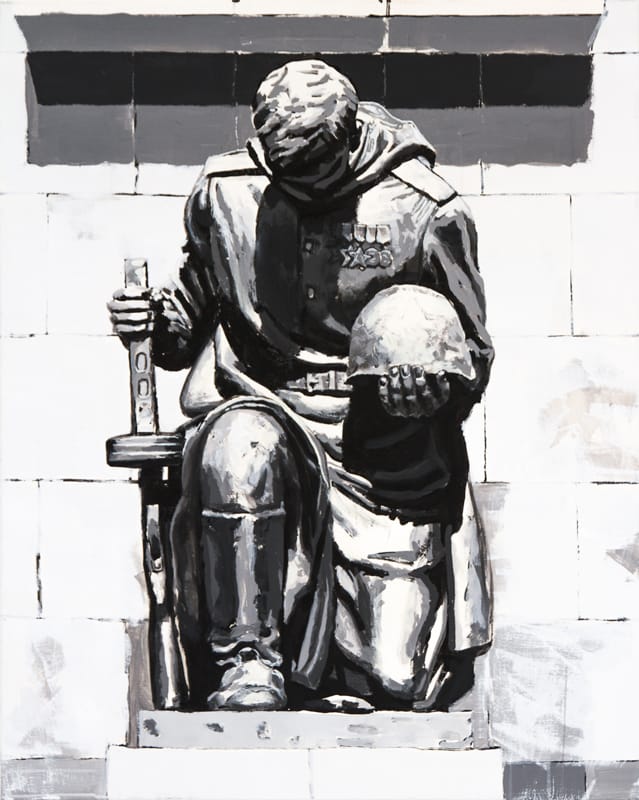
Unbekannter Soldat
Sowjetisches Ehrenmal Treptow
SF-P 17-13
Unique
Signed
Sergio Frutos
, 2017
Acrylic on canvas
100 x 80 x 2 cm
SF-P 17-13
Unique
Signed
 View in a room
 Download PDF
About this artwork:
The Soviet War Memorial is a war memorial and military cemetery in Berlin's Treptower Park. It was built to the design of the Soviet architect Yakov Belopolsky to commemorate 7,000 of the 80,000 Red Army soldiers who fell in the Battle of Berlin in April–May 1945. The Memorial served as the central war memorial of East Germany. The main entrance to the complex is flanked by two kneeling generic soldiers and two stylized red granite soviet flags.
About the project: NATURAL HISTORY
A cabinet of curiosities —or Wunderkammer— stored and exhibited a wide variety of objects and artifacts, with a particular leaning towards the rare, eclectic and esoteric. Through the selection of objects, they told a particular story about the world and its history.
Appearing in Renaissance Europe, the ‘cabinet of curiosities’ is an early ancestor of the modern science or natural history museums.1 They also played a fundamental role in the development of modern science, even if they weren’t always that ‘scientific’ — it was not uncommon to find dried dragon blood or mythical animal skeletons in their collections. The popularity of the cabinet of curiosities waned during the nineteenth century, as it was replaced by official institutions and private collections.
The cabinets commonly featured antiques, objects of natural history (such as stuffed animals, dried insects, shells, skeletons, shells, herbarium, fossils2) and even works of art. In cabinets of curiosities, collections were often organized into about four categories:
Artificialia, which groups the objects created or modified by human (antiques, works of art);
Naturalia, which includes creatures and natural objects (with a particular interest in monsters);
Exotica, which includes exotic plants and animals; and
Scientifica, which brings together scientific instruments.
Natural History is a collection of paintings that resemble the first science museums and follow this schema to configure a mix of history facts, personal experiences and found objects, depicted by the symbolic interaction of the paintings, in a personal and particular Cabinet of Curiosities.
The origin of those Wunderkammern is linked to the Illustration and the rationalistic approach to reality that emerges with the renaissance and accompanied the industrial and technological revolution that configured our modern world, but are also related to the expansion of young capitalism, colonization and depredation by the western powers.3
The expropriation and assimilation in museums is a perverse mechanism where the handling and care of those treasures disconnects them from the violent colonial looting from which they come from, and from the dispossessed, the who have been expropriated from their land, culture, future and past.4
The early Cabinets of Curiosities inspired me to create my own collection of rare, personally interesting objects in the series Natural History, in an intent to bypass the official, colonial5 core of the original collections. Those were found objects, personal belongings with a particular story, and images found in natural science museums archives.
-
Anne Wallentine, “How Cabinets of Curiosities Laid the Foundation for Modern Museums,” Smithsonian Magazine, 2024. →
-
Mark Thurner and Juan Pimentel, “New World Objects of Knowledge: A Cabinet of Curiosities” (University of London Press, 2021), 301.→
-
Deirdre Pretorius, “Dead Living Things: A Cabinet of Curiosities in the Postcolony,” De Arte 57, no. 2 (2022): 33–60, →
-
Ariella Azoulay, Potential History: Unlearning Imperialism. London ; Brooklyn, NY: Verso, 2019.
-
James Clifford, The Predicament of Culture: Twentieth-Century Ethnography, Literature, and Art. Cambridge, Mass: Harvard University Press, 1988. → →
