


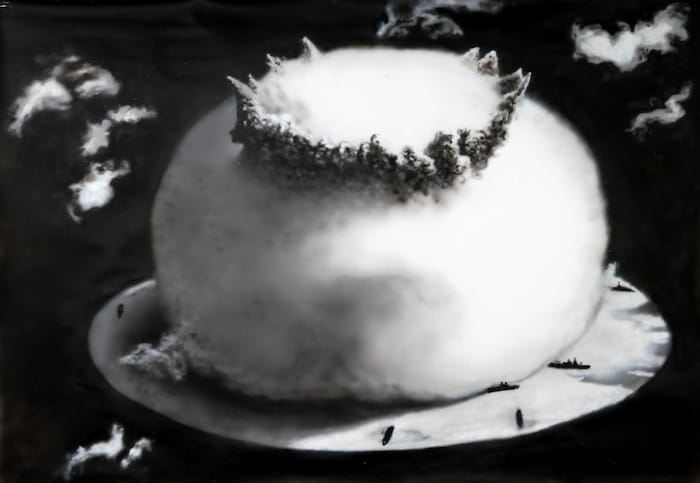

Operation Crossroads II
SF-P 17-2
Unique
Signed
Sergio Frutos
, 2017
Ink and acrylic on paper
70 x 100 cm
Framed 90 x 120 x 3 cm
SF-P 17-2
Unique
Signed
 View in a room
 Download PDF
About this artwork:
Operation Crossroads was a pair of nuclear weapon tests conducted by the United States at Bikini Atoll in mid-1946. The Crossroads tests were the first of many nuclear tests held in the Marshall Islands and the first to be publicly announced beforehand and observed by an invited audience, including a large press corps. They were the first nuclear weapon tests since Trinity on July 16, 1945, and the first detonations of nuclear devices since the atomic bombing of Nagasaki on August 9, 1945.
A fleet of 95 target ships was assembled in Bikini Lagoon and hit with two detonations of the kind dropped on Nagasaki to investigate the effect of nuclear weapons on warships.
Pressure to cancel Operation Crossroads altogether came from scientists and diplomats. Manhattan Project scientists argued that further testing was unnecessary and environmentally dangerous. When the scientists pointed out that the tests might demonstrate ship survivability while ignoring the effect of radiation on sailors1, the organizers responded by adding test animals to some of the ships, thereby generating protests from animal rights advocates2.
The second test was Baker. The bomb was known as Helen of Bikini and was detonated 27 m underwater on July 25, 1946. The Baker shot produced so many unusual phenomena that a conference was held two months later to standardize nomenclature and define new terms for use in descriptions and analysis3. The underwater fireball removed all the water within a 150 m radius and lifted two million tons of spray and seabed sand into the air, stretching into a cylinder 1.800 m tall and 600 m wide.
It was understood that if the water column fell back into the lagoon, which it did, any ships that were drenched by falling water might be contaminated beyond redemption. Nobody expected that to happen to almost the entire target fleet. No decontamination procedures had been tested to see if they would work and to measure the potential risk to personnel. In the absence of a decontamination protocol, the ships were cleaned using traditional deck-scrubbing methods: hoses, mops, and brushes, with water, soap, and lye. The sailors had no protective clothing4.
Bikini's native residents were evacuated and relocated in a desert island where they starved until relocated again. Bikini remains uninhabited, though it is occasionally visited by sport divers, who must eat imported food.
The Able bomb was stenciled with the name Gilda and decorated with an Esquire magazine photograph of Rita Hayworth, star of the 1946 movie, Gilda5. The Baker bomb was Helen of Bikini. This femme-fatale theme for nuclear weapons, combining seduction and destruction, is epitomized by the use in all languages, starting in 1946, of "bikini" as the name for a woman's two-piece bathing suit.
During Operation Crossroads, Paris swimwear designer Louis Réard adopted the name Bikini for his minimalist swimsuit design which, revolutionary for the time, exposed the wearer's navel. He explained that “like the bomb, the bikini is small and devastating”6. Fashion writer Diana Vreeland described the bikini as the "atom bomb of fashion". While two-piece swimsuits have been used since antiquity, it was Réard's name of the Bikini that stuck for all of its modern incarnations.7
Crossroads has been described as one of the most photographed events in history, and this had had several practical effects for moviemakers, even before the first weapon had been exploded. As more than half the world’s available stock of film footage was bought up for cameras to record the tests, there were months of shortages in Hollywood and other major studios around the world.
The Godzilla movies use the Baker test footage or depict Operation Crossroads as the cause of Godzilla's mutation in the first place. The test Baker explosion archival footage is also used in the Stanley Kubrick film Dr. Strangelove.8
-
Rabinowitch, Eugene, and Hyman H. Goldsmith, eds. “Operation Crossroads: The Effect of the Atomic Bomb on Naval Power.” Bulletin of the Atomic Scientists (Chicago) 1, no. 5 (February 1946): 1. →
-
Delgado, James P., and Daniel J. Lenihan. The Archeology of the Atomic Bomb. A Submerged Cultural Resources Assessment of the Sunken Fleet of Operation Crossroads at Bikini and Kwajalein Atoll Lagoons. No. 37. Santa Fe, New Mexico: National Park Service, 1991. →
-
W. A. Shureliff, Bombs at Bikini. The Official Report of Operation Crossroads (New York: W. H. Wise, Joint Task Force One, 1947). →
-
Jonathan M. Weisgall, Operation Crossroads : The Atomic Tests at Bikini Atoll (Annapolis: Naval Institute Press, 1994). →
-
Bill Geerhart, “Atomic Goddess Revisited: Rita Hayworth’s Bomb Image Found,” CONELRAD Adjacent, August 13, 2013. →
-
“1945-1950: The Very First Bikini.” bikiniscience.com, 27 June 2012. →
-
Rose Eveleth. “The Bikini’s Inventor Guessed How Much It Would Horrify the Public.” Smithsonian Magazine, July 5, 2013. →
-
Timothy Noël Peacock, Josephine Lethbridge, and Paul Keaveny. “From Crossroads to Godzilla: The Cinematic Legacies of the First Postwar Nuclear Tests.” The Conversation, July 22, 2021. →
About the project: ATOM
[...]
“And so?” you ask your guide, the nice one.
“So, we learned to make stars,” he answers.
“I thought you told me that this was already like a sun.”
“Oh, yes, but it's not a real sun. Real suns don't work like that. They're much more powerful. So we made real stars.”
“I can't believe it.”
“And what do you think that white powder you've got there and this thermos I've got here are for?”
“The stuff that stars are made of?”
“Yes. And nightmares.”
Antonio Cantó, “Así funciona un arma termonuclear. (How a thermonuclear weapon works)” La pizarra de Yuri: historias de ciencia al calor del fuego (Yuri's blackboard: science stories by the fire). Guadalajara ; Madrid: Silente, 2011. →
The project Atom is based on archival photographs from nuclear tests and revolves around how the ‘atomic age’ is a turning point1 and to which extent human stupidity can destroy the world we live in. Is possible the survival of humanity and living beings with whom we share the planet as we know it under the current system?.
The phrase “atomic age” has been around since 1945 in reference to the world’s reframing by the newfound human control over nuclear forces. Nuclear weapons prompted both apocalyptic visions of humanity’s annihilation through mutually assured destruction and promises of abundance, progress, and modernity through the utilization of atomic energy.
On the one side, the atrocities of mass destruction in Japanese cities, on Pacific Atolls, and other “testing sites” across the globe forever stamped the self-image of the human as an engineer of death. On the other side, harnessing nuclear power and the emerging nuclear sector were hailed as instruments of national security, a hotbed of technological innovation, a wellspring for electric household energy, and a radically modern means of investigating the natural world and improving human bodies and diets. But soon the smiling side of this Janus face faded, and threat of radioactivity became the scare phenomenon of the second half of the twentieth-century. Radioactive contamination has changed the natural and the social environment to an extent that brings a whole new register into focus: the possibility that life on this planet could end as we know it.2
Our current development, predating the planet, following the dictates of capitalism will certainly drive us to mass extinction.3
Since the nuclear test race in 40s and 50s, the world has advanced in nuclear technology. Today, a nuclear bomb could target a large-scale attack, at a longer range, and with much greater destructive force. People are increasingly concerned about the potential destructive humanitarian outcomes.4 So long as nuclear weapons exist, it is inevitable that someday they will be used, whether by design, accident, or miscalculation. The danger of use of nuclear weapons is greater than ever before due to proliferation of nuclear weapons, terrorism, and political instabilities.5
-
Paul Crutzen and Christian Schwägerl, “Living in the Anthropocene: Toward a New Global Ethos.” Yale E360, January 24, 2011. →
-
A. Cundy, et al., “Radioactive Fallout as a Marker for the Anthropocene.” In: C. Rosol and G. Rispoli (eds) Anthropogenic Markers: Stratigraphy and Context, Anthropocene Curriculum. Berlin: Max Planck Institute for the History of Science, 2022. →
-
Troy Vettese, “A Marxist Theory of Extinction.” Salvage, January 1, 2019. →
-
Shan Xu and Alicia Dodt, “Nuclear Bomb and Public Health.” Journal of Public Health Policy 44, no. 3 (2023): 348–59. →
-
Kathleen Kingsbury et al. “At the brink: Confronting the risk of nuclear war.” Opinion. The New York Times, October 10, 2024. →
Silly Asses
Isaac Asimov
Naron of the long-lived Rigellian race was the fourth of his line to keep the galactic records.
He had the large book which contained the list of the numerous races throughout the galaxies that had developed intelligence, and the much smaller book that listed those races that had reached maturity and had qualified for the Galactic Federation. In the first book, a number of those listed were crossed out; those that, for one reason or another, had failed. Misfortune, biochemical or biophysical shortcomings, social maladjustment took their toll. In the smaller book, however, no member listed had yet blanked out.
And now Naron, large and incredibly ancient, looked up as a messenger approached.
“Naron,” said the messenger. “Great One!”
“Well, well, what is it? Less ceremony.”
“Another group of organisms has attained maturity.”
“Excellent. Excellent. They are coming up quickly now. Scarcely a year passes without a new one. And who are these?”
The messenger gave the code number of the galaxy and the coordinates of the world within it.
“Ah, yes,” said Naron. “I know the world.” And in flowing script he noted it in the first book and transferred its name into the second, using, as was customary, the name by which the planet was known to the largest fraction of its populace. He wrote: Earth.
He said, “These new creatures have set a record. No other group has passed from intelligence to maturity so quickly. No mistake, I hope.”
“None, sir,” said the messenger. “They have attained to thermonuclear power, have they?”
“Yes. sir.”
“Well, that’s the criterion.” Naron chuckled. “And soon their ships will probe out and contact the Federation.”
“Actually, Great One,” said the messenger, reluctantly, “the Observers tell us they have not yet penetrated space.”
Naron was astonished. “Not at all? Not even a space station?”
“Not yet, sir.”
“But if they have thermonuclear power, where then do they conduct their tests and detonations?”
“On their own planet, sir.”
Naron rose to his full twenty feet of height and thundered, “On their own planet?”
“Yes, sir.”
Slowly Naron drew out his stylus and passed a line through the latest addition in the smaller book. It was an unprecedented act, but, then, Naron was very wise and could see the inevitable as well as anyone in the galaxy.
“Silly asses,” he muttered.
First published in: Future Science Fiction, February 1958, p. 114
Collections:
Have You Seen These?
Buy Jupiter and Other Stories